RpcNode
WalletAPIServer extends the abstract class RpcNode, which implements the JSON-RPC 2.0 plumbing shared between the server and the client. Knowing what RpcNode provides is useful when you implement a custom transport or read stack traces.
Class diagram overview
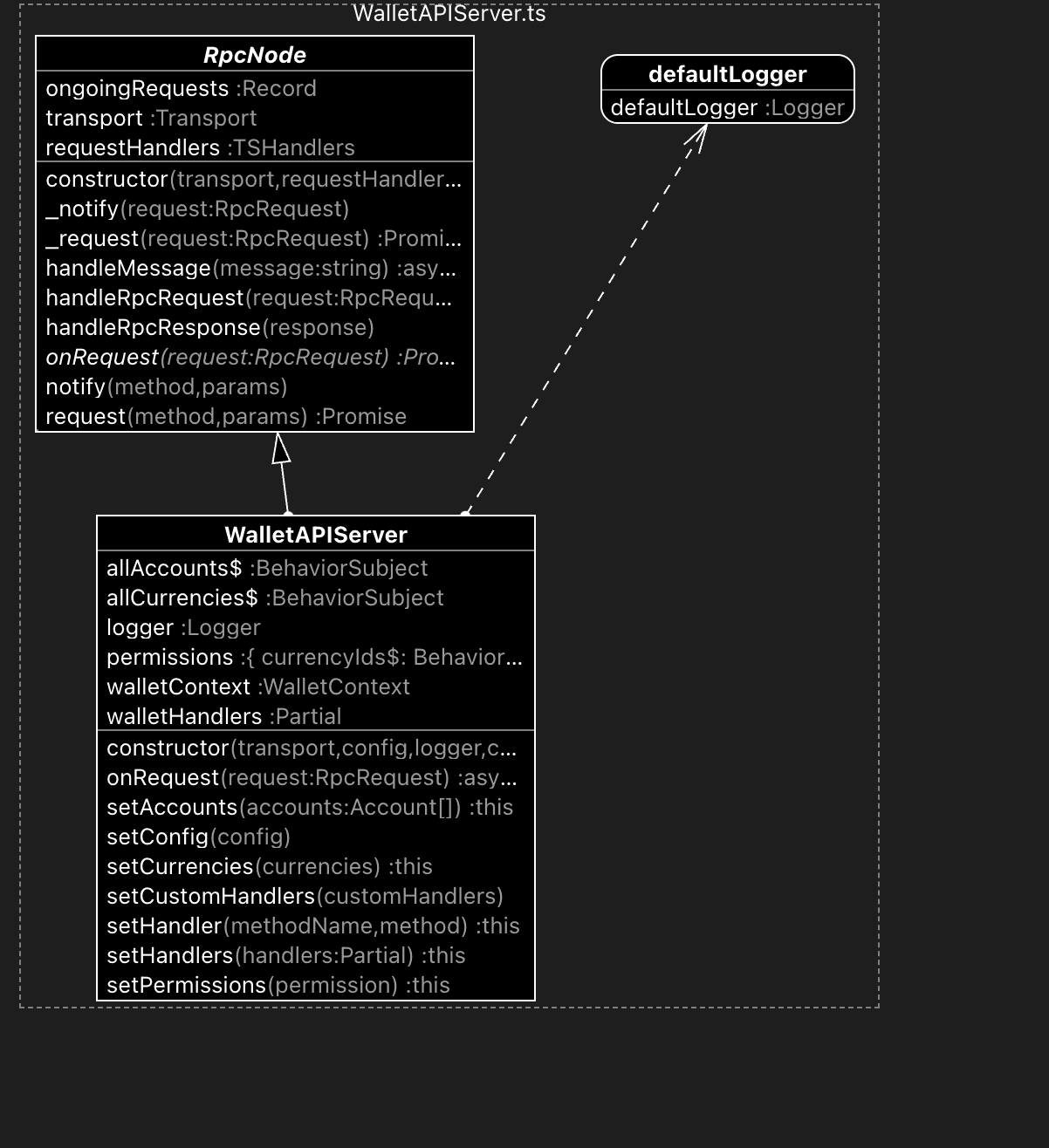
Type parameters
abstract class RpcNode<TSHandlers, TCHandlers>| Parameter | Meaning |
|---|---|
TSHandlers | The handlers exposed to the other side for this node. For the server, these are the request handlers. |
TCHandlers | The handlers available on the other side, used to type the request / notify calls this node emits. |
Properties
| Property | Visibility | Set via | Purpose |
|---|---|---|---|
transport | private | constructor | The transport used to read and write JSON-RPC messages. |
requestHandlers | protected | constructor | The handlers that fulfil incoming requests. |
ongoingRequests | private | populated by _request | Pending request promises keyed by request ID. The resolver is called when a matching response arrives. |
The constructor sets transport.onMessage to its own handleMessage so any incoming string is routed through RpcNode.
Methods
Public
request<K>(method: K, params: P): Promise<R | undefined>
notify<K>(method: K, params: P): void| Method | Use it to | Notes |
|---|---|---|
request | Send a JSON-RPC request and await the response. | Generates a UUID v4 for the request id, stores a resolver in ongoingRequests, sends { jsonrpc: "2.0", id, method, params } over the transport, and resolves with the response’s result (or rejects with the error). |
notify | Send a JSON-RPC notification (no response expected). | No id is generated; the receiver does not reply. |
Internal flow
| Method | Visibility | Role |
|---|---|---|
handleMessage | private | Routes an incoming message to handleRpcRequest (when it has a method) or handleRpcResponse (when it has a result/error). |
handleRpcRequest | private | Calls onRequest(request), builds the response, and writes it to the transport. Translates exceptions into RpcErrors (see below). |
handleRpcResponse | private | Looks up the resolver in ongoingRequests by ID and resolves it. Throws if no matching request is found. |
onRequest | abstract, protected | Subclasses must implement this. WalletAPIServer.onRequest looks up requestHandlers[method], checks the permissions, and invokes the handler. |
Error handling
RpcNode translates thrown exceptions into JSON-RPC error responses with the following codes (defined in packages/core/src/JSONRPC/types.ts):
| Code | Name | Raised when |
|---|---|---|
-32700 | PARSE_ERROR | Invalid JSON received. |
-32600 | INVALID_REQUEST | Message is not a valid JSON-RPC request. |
-32601 | METHOD_NOT_FOUND | requestHandlers has no entry for the method ID. |
-32602 | INVALID_PARAMS | Zod validation of params fails (error.flatten() is attached as data). |
-32603 | INTERNAL_ERROR | Internal JSON-RPC error. |
-32000 | SERVER_ERROR | A ServerError (for example the wallet not implementing a handler) was thrown. The original error data is wrapped in data. |
On the requesting side, _request re-hydrates these errors: SERVER_ERRORs with code UNKNOWN_ERROR are deserialized via @ledgerhq/errors and rejected as the original error class; everything else is rejected as a RpcError.
RPC request and response types
type RpcRequest<MParam = string, TParam = unknown> = {
  jsonrpc: "2.0";
  method: MParam;
  params?: TParam;
  id?: string | number | null;
};

type RpcResponse<TResult = unknown, TErrorData = unknown> =
  | { jsonrpc: "2.0"; id: string | number | null; result?: TResult }
  | { jsonrpc: "2.0"; id: string | number | null; error: RpcResponseError<TErrorData> };
A request without an id is a notification: no response is sent.
See also
- Server reference:
requestHandlers,walletHandlers, and permissions. RpcNodesource.- JSON-RPC 2.0 specification .
